Example: A Simple Loop
The following program implements addition using a C for loop.
int slow_add(int x, int y)
  /*@ Require
        0 <= x && x <= 100 &&
        0 <= y && y <= 100
      Ensure
        __return == x + y
   */
{
  int i;
  /*@ Inv Assert
        y == y@pre + i && x == x@pre &&
        0 <= i && i <= x@pre &&
        0 <= x@pre && x@pre <= 100 &&
        0 <= y@pre && y@pre <= 100
   */
  for (i = 0; i < x; ++ i) {
    y ++;
  }
  return y;
}
The annotation beginning with Inv Assert is the loop invariant. It states that every time the program checks the for loop condition i < x, the program variables satisfy this condition. This is illustrated in the figure below.
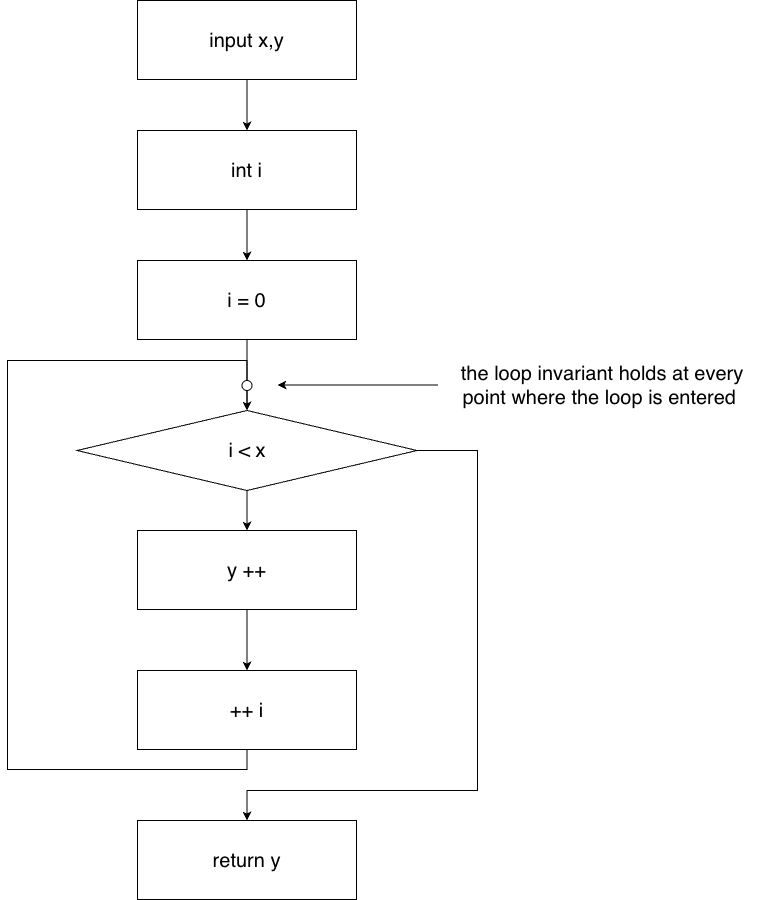
In this assertion, x@pre and y@pre denote the values of the two parameters at the time they were passed into the function. In other words, the assertion states: the current value of y equals the initial value of y plus i, and i is in the range from 0 to x. Based on this loop invariant, QCP only needs to check the following 3 conditions to confirm that this C function indeed implements addition:
- After the initialization
i = 0, the program state satisfies the invarianty == y@pre + i && x == x@pre && 0 <= i && i <= x@pre(properties regardingx@preandy@prethemselves are omitted here for brevity, and likewise below); - If the program state satisfies the invariant
y == y@pre + i && x == x@pre && 0 <= i && i <= x@preand the loop body will be entered (i.e.,i < xis true), then after executing the loop bodyy ++and++ i, the loop invariant still holds; - If the program state satisfies the invariant
y == y@pre + i && x == x@pre && 0 <= i && i <= x@preand the loop body will not be entered (i.e.,i < xis false), then executing thereturn ystatement after the loop guarantees that theEnsurecondition__return == x@pre + y@preholds.
Since x@pre and y@pre are both known to be in the range 0 to 100, it is straightforward to verify that all three properties hold, and QCP can verify this automatically.