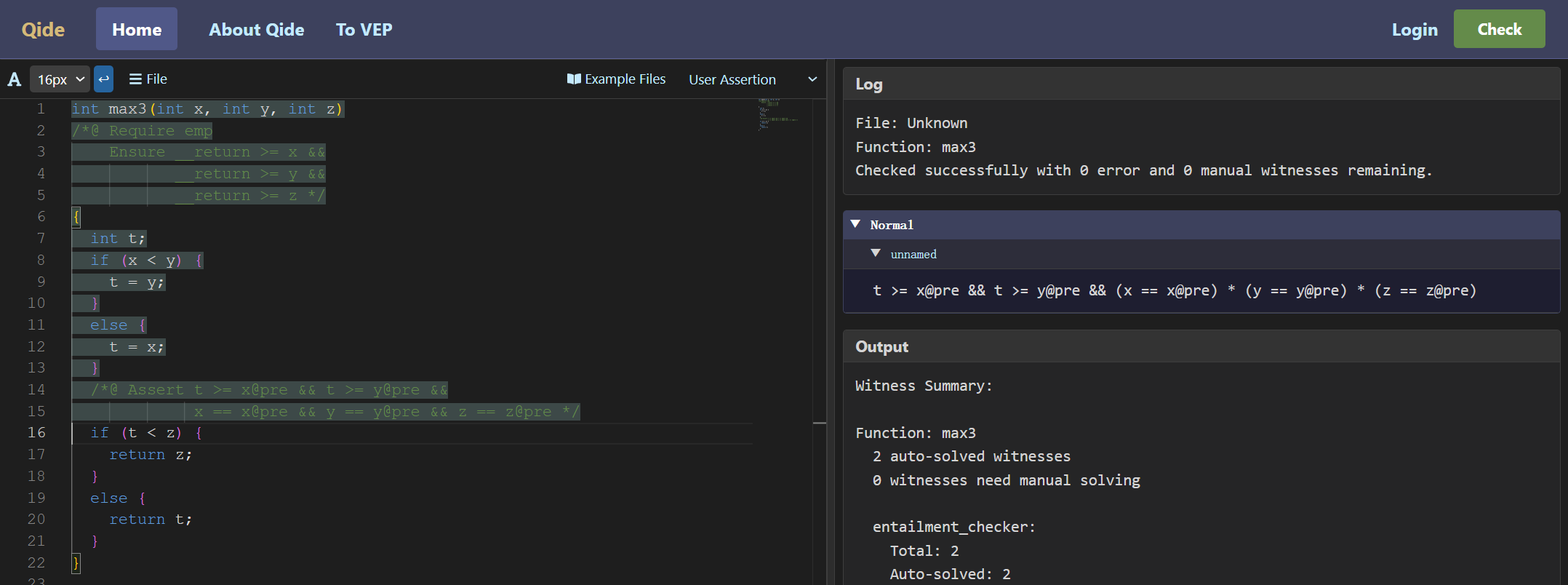
swap函数中增加断言标注后的符号执行
以前面曾经介绍过的swap函数为例。
void swap(int * px, int * py)
/*@ With x y
    Require store_int(px, x) * store_int(py, y)
    Ensure store_int(px, y) * store_int(py, x) */
{
  int t;
  t = * px;
  * px = * py;
  * py = t;
}
第一条赋值语句执行后,程序状态满足下面断言(这也是QCP符号执行器会得到的最强后条件):
store_int(&t, x) *
store_ptr(&px, px_37) *
store_ptr(&py, py_40) *
store_int(px_37, x) *
store_int(py_40, y)
其中,px_37和py_40表示px@pre和py@pre这两个初始值。当然,我们看了后续程序,我们知道此时* px存储的值是没有用的。下面我们就在这个程序点上断言了这个弱一些的性质。
void swap(int * px, int * py)
/*@ With x y
    Require store_int(px, x) * store_int(py, y)
    Ensure store_int(px, y) * store_int(py, x) */
{
  int t;
  t = * px;
  /*@ Assert
        store_int(&t, x) *
        store_ptr(&px, px@pre) *
        store_ptr(&py, py@pre) *
        has_int_permission(px@pre) *
        store(py@pre, y) */
  * px = * py;
  * py = t;
}
添加这条断言就表示“程序执行到此处时程序状态必定满足此性质”,并且后续程序语句的正确性也仅仅由此性质保障。换言之,哪怕我们实际可以论证程序执行到此处时满足更强的性质,后续程序语言的验证也无需用到更强的性质。因此,如果QCP在验证过程中遇到这样带标注的程序,就会生成一条下面这样的验证条件,并且基于用户给出的断言进行后续的符号执行。
store_int(&t, x) *
store_ptr(&px, px_37) *
store_ptr(&py, py_40) *
store_int(px_37, x) *
store_int(py_40, y)
|-- store_int(&t, x) *
    store_ptr(&px, px_37) *
    store_ptr(&py, py_40) *
    has_int_permission(px_37) *
    store_int(py_40, y)
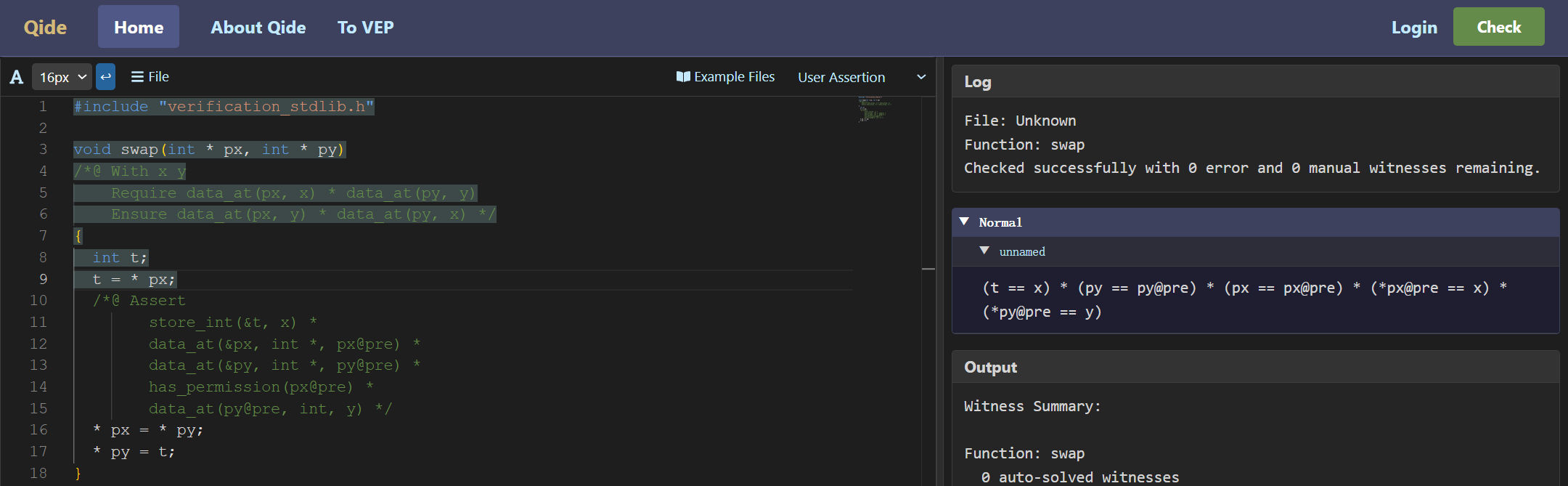
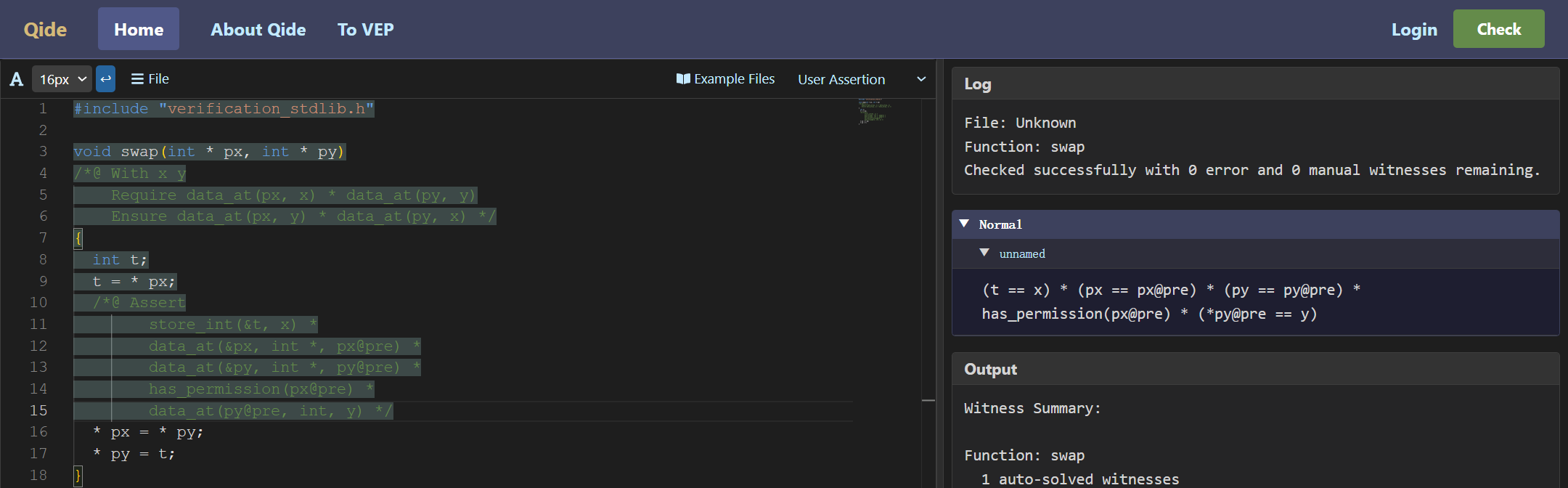
下面两图中可以看到符号执行该断言前后的对比。符号执行该断言之后,Normal断言列表中显示了断言标注中引入的has_permission谓词。
符号执行if语句后的断言标注
下面max3函数计算了三个整数的最大值。
int max3(int x, int y, int z)
/*@ Require emp
    Ensure __return >= x &&
           __return >= y &&
           __return >= z */
{
  int t;
  if (x < y) {
    t = y;
  }
  else {
    t = x;
  }
  /*@ Assert t >= x@pre && t >= y@pre &&
             x == x@pre && y == y@pre && z == z@pre */
  if (t < z) {
    return z;
  }
  else {
    return t;
  }
}
该函数包含两个if语句,我们已经熟悉,符号执行完第一个if语句后,会得到两条Normal断言:
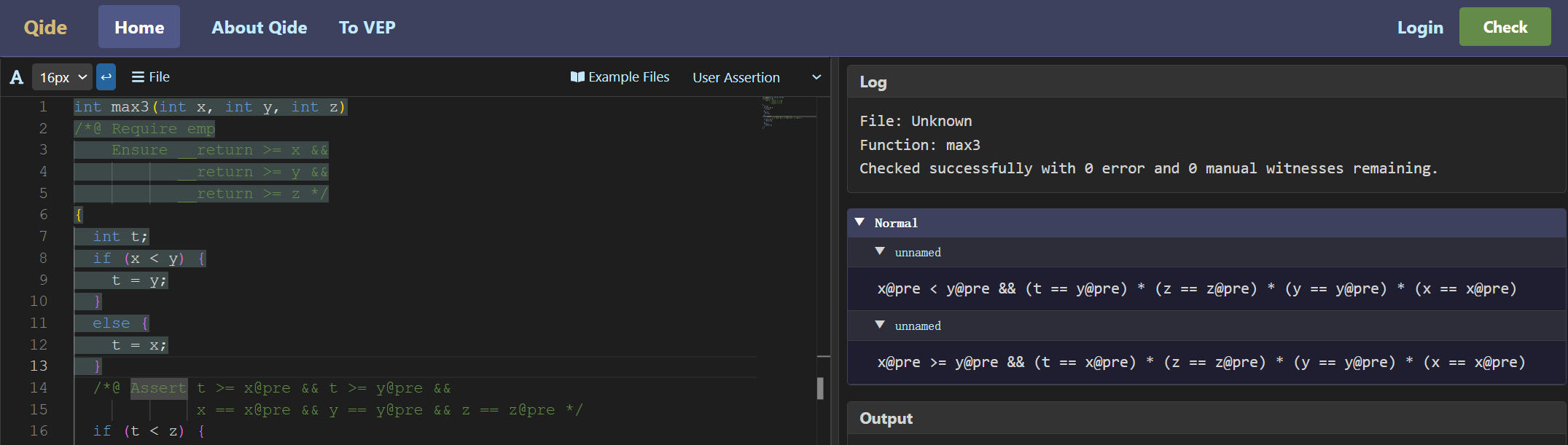
现在,如果符号执行这条if语句之后的断言标注,那么就会生成两个验证条件,即需要检验上面两条Normal断言都能推出这条手动插入的断言。以下是两个验证条件,断言都已经用基本分离逻辑断言表示,其中x_54、y_51与z_48分别是三个形参的初始值。
x_54 < y_51 &&
store_int(&t, y_51) *
store_int(&x, x_54) *
store_int(&y, y_51) *
store_int(&z, z_48)
|--
exists t_64,
t_64 >= x_54 &&
t_64 >= y_51 &&
store_int(&t, t64) *
store_int(&x, x_54) *
store_int(&y, y_51) *
store_int(&z, z_48)
x_54 >= y_51 &&
store_int(&t, y_51) *
store_int(&x, x_54) *
store_int(&y, y_51) *
store_int(&z, z_48)
|--
exists t_64,
t_64 >= x_54 &&
t_64 >= y_51 &&
store_int(&t, t64) *
store_int(&x, x_54) *
store_int(&y, y_51) *
store_int(&z, z_48)
符号执行该断言标注后,QCP的符号执行其将只使用这一条Normal断言进行后续的符号执行,而不再保留两个分支。