struct int_pair {
    int a;
    int b;
};
Definition store_int_pair (p: addr) (x y: Z): Assertion :=
  &(p # "int_pair" ->ₛ "a") # Int |-> x **
  &(p # "int_pair" ->ₛ "b") # Int |-> y.
不过,有些时候在验证相关结构体的操作时,我们希望总是将其信息放在一个store_int_pair谓词中,使得符号执行需要处理的断言变得更简洁。QCP也能支持用户通过定制断言变换策略实现这一功能。
具体而言,用户需要在.strategies文件中增加以下断言变换策略:
id : 4
priority : post(1)
left : store(field_addr(?p, int_pair, a), I32, ?x) at 0
       store(field_addr(p, int_pair, b), I32, ?y) at 1
action : left_erase(0);
         left_erase(1);
         left_add(store_int_pair(p, x, y));
这个断言变换策略中有一个关键字是post,这不同于之前例子中的core,它表示在内存读写的符号执行之后,自动进行此断言变换。而不是为了对内存读写做符号执行而事先做的断言变换。
现在,符号执行的全程都只会显示store_int_pair谓词,swap_int_pair函数的符号执行也不会生成任何一个验证条件。
符号执行int temp = p->a后,得到断言:
store_int_pair(p@pre, x, y) *
store_int(&temp, x) *
store_ptr(&p, p@pre)
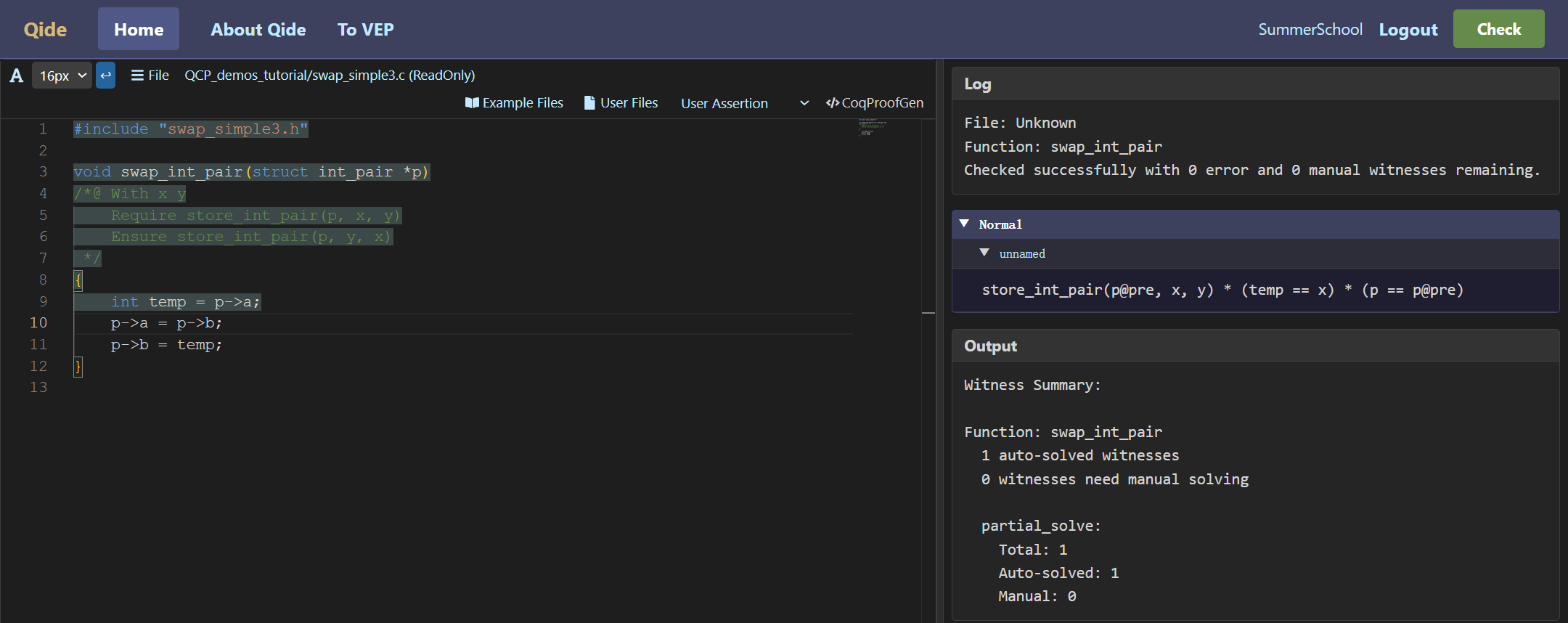
符号执行p->a = p->b后,得到断言:
store_int_pair(p@pre, y, y) *
store_int(&temp, x) *
store_ptr(&p, p@pre)
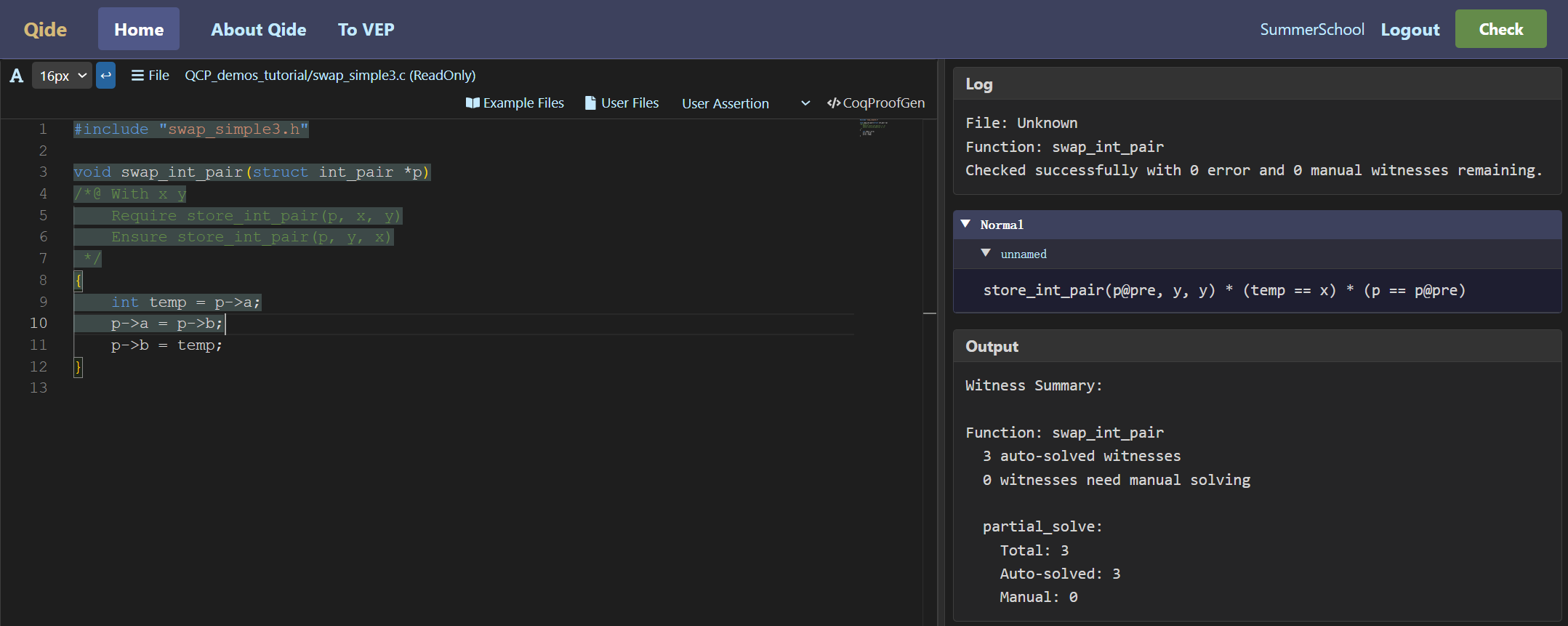
符号执行p->b = temp后,得到断言:
store_int_pair(p@pre, y, x) *
store_int(&temp, x) *
store_ptr(&p, p@pre)
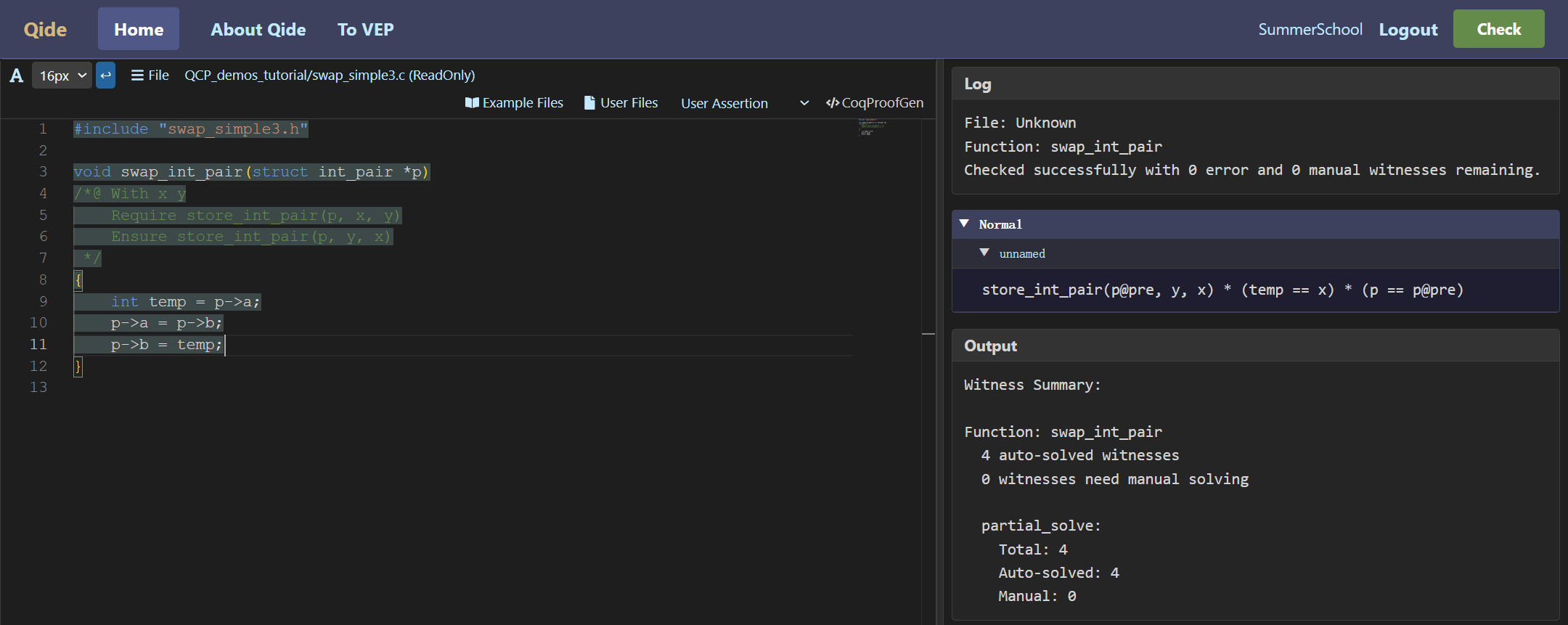
在此基础上,释放临时变量temp和p的内存空间,就直接得到了Ensure条件。这样,QCP就不会额外产生需要用户手动在Rocq中证明的VC了。